Prorated Rent Calculator: Daily Rate Formula & Calculation Methods (2026)
Mid-month move-ins and move-outs raise one question every time: how much rent is actually owed for a partial month? The formula itself is simple, but the method behind it — actual days versus a flat 30-day count — is where most landlord-tenant disputes start. This guide breaks down the exact daily rate formula, compares the three calculation methods in use today, and covers the state-specific rules that actually matter.
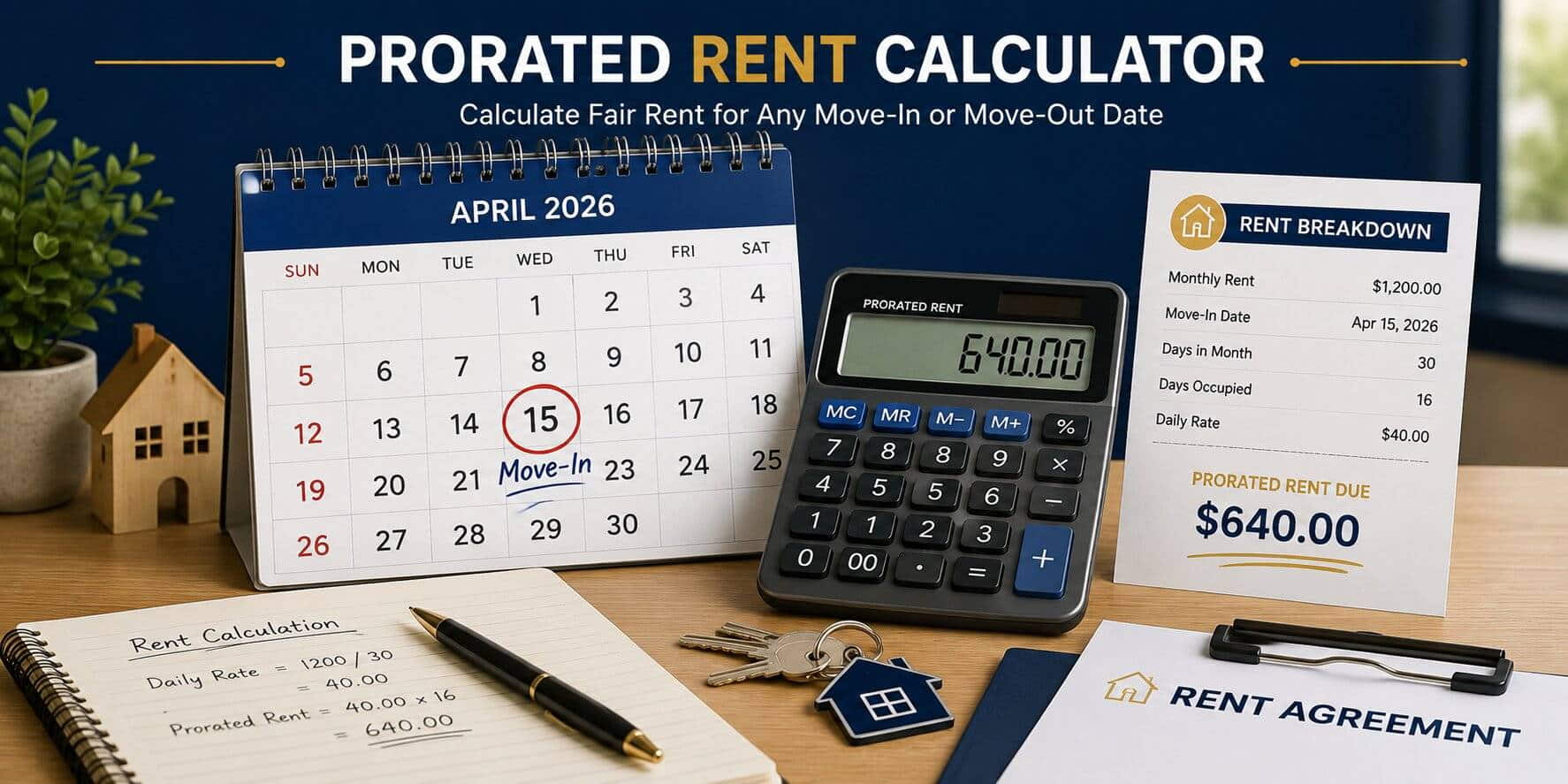
Prorated rent adjusts for the exact days a unit is occupied, not a flat monthly charge.
What Is Prorated Rent?
Prorated rent is the adjusted rental amount charged when a tenant doesn't occupy a property for a full billing cycle. Instead of paying a full month's rent, the charge is scaled down to match the actual days of occupancy — common on move-in day, move-out day, or when a lease starts or ends mid-cycle.
Core Formula: (Monthly Rent ÷ Days in That Month) × Days Occupied. This is the actual-days method, and it's the one most courts and landlord-tenant statutes default to when a dispute arises.
3 Ways to Calculate Prorated Rent
Not every landlord or lease uses the same formula. Here's how the three common methods compare — and why the differences matter more than they look.
| Method | Formula | Accuracy |
|---|---|---|
| Actual-Days (most defensible) | Monthly Rent ÷ Days in That Month × Days Occupied | Most accurate — adjusts for 28–31 day months |
| Flat 30-Day | Monthly Rent ÷ 30 × Days Occupied | Simple but slightly overcharges in 31-day months, undercharges in February |
| Banker's Rule (365-day average) | (Monthly Rent × 12) ÷ 365 × Days Occupied | More precise than flat 30-day, still less accurate than actual-days |
Worked example: A tenant moves in March 15th with $1,800 monthly rent. Actual-days method: $1,800 ÷ 31 days × 17 days occupied = $987.10. Flat 30-day method: $1,800 ÷ 30 × 17 = $1,020. That's a real $33 difference from method choice alone — which is exactly why disputes happen.
Try the Prorated Rent Calculator
Enter your monthly rent and move-in or move-out date to get the exact prorated amount using the actual-days method.
Use Prorated Rent Calculator →Does Your State Require a Specific Method?
Most states leave proration to the lease agreement, but a handful have explicit rules or strong court precedent favoring one method. This is general information, not legal advice — always check your specific state and lease terms.
| State | Rule |
|---|---|
| California | Civil Code explicitly requires daily proration for month-to-month tenancies ended with proper notice — not optional |
| New York | No single statute, but the daily-rate method is standard practice, especially for rent-stabilized units |
| Texas | Not legally mandated; lease agreement governs, courts may apply a reasonableness standard if the lease is silent |
| Florida | No specific proration law; courts have accepted both actual-days and 30-day methods depending on the case |
| Pennsylvania | Not statutorily required, but courts have ruled proration must be "reasonable and proportionate" — typically actual-days |
Common Prorated Rent Mistakes
- Using a flat 30 days for every month: Slightly overcharges tenants in 31-day months and undercharges in February.
- Switching methods to favor one side: Using actual-days for move-in but 30-day for move-out — whichever benefits the landlord — is inconsistent and can create legal risk.
- Prorating the security deposit: A security deposit is never prorated. It's always charged in full regardless of move-in date, since it secures the entire tenancy, not just the first partial month.
- Excluding the move-in day: Most methods count the move-in day itself as a full day of occupancy — leaving it out under-charges the correct amount.
- No written record: A verbal agreement on the calculation method leads to disputes later. Always document the formula and result in writing (a text or email is enough).
Checklist: What to Verify Before You Pay or Charge
For Tenants
- Budget accurately for initial moving expenses
- Verify landlord-provided move-in cost estimates against the actual-days formula
- Understand final-month charges when moving out before month-end
- Confirm the security deposit isn't being incorrectly prorated
For Landlords
- Generate accurate, consistent move-in cost sheets
- Calculate final payments for departing residents
- Apply one method consistently to avoid fair-housing and consistency disputes
- Reduce back-and-forth with tenants over move-in/move-out charges
Once you've confirmed the right method for your situation, plug in your numbers on the Prorated Rent Calculator for the exact figure — no manual math required.
Complementary Tools for Rental Management
Useful Calculator Tools
- Salary Calculator — verify tenant income requirements
- Percentage Calculator — calculate rent increases
- Time Zone Converter — coordinate with out-of-state landlords or tenants
- Word Counter — review lease agreements and rental documents
Frequently Asked Questions
How do you calculate prorated rent?
Divide the monthly rent by the actual number of days in that specific month to get a daily rate, then multiply the daily rate by the number of days the tenant occupies the unit, including the move-in day.
Should I use 30 days or the actual days in the month?
The actual-days method is the most widely accepted and legally defensible approach, since it accounts for months ranging from 28 to 31 days. The 30-day method is simpler but slightly overcharges tenants in 31-day months and undercharges in February.
What's the difference between this guide and the calculator tool?
This guide explains the three calculation methods, state-specific rules, and common landlord-tenant mistakes in depth. The calculator tool itself is built for quick, instant results — once you know which method applies to your situation, enter your rent and dates there for the exact figure.
Is a security deposit ever prorated?
No. A security deposit is always charged in full regardless of the move-in date, since it secures the entire tenancy rather than just the first partial month.
How is prorated rent calculated for a move-out?
The same formula applies: divide the monthly rent by the days in that month to get the daily rate, then multiply by the number of days occupied through the move-out date.
Do you count the move-in day when calculating prorated rent?
Yes. The move-in day is generally counted as a full day of occupancy in most calculation methods and lease agreements.
What is the Banker's Rule method for prorating rent?
The Banker's Rule, sometimes called the 365-day average method, uses a fixed daily rate calculated as (Monthly Rent × 12) ÷ 365. It's more precise than the flat 30-day method but still less accurate than using the actual days in the specific month.
Can a landlord charge different proration methods for move-in versus move-out?
Using inconsistent methods — for example, actual-days for move-in but 30-day for move-out, whichever benefits the landlord — is considered unfair practice and can create legal risk. The same method should be applied consistently.
Does California require prorated rent by law?
Yes. California Civil Code addresses proration for month-to-month tenancies terminated with proper notice, and California courts have favored the actual-days method as the fair and defensible standard.
Does New York require a specific proration method?
New York law doesn't explicitly mandate a single method by statute, but the daily-rate approach using actual days in the month is the standard practice, particularly for rent-stabilized units.
What's the most common mistake landlords make when prorating rent?
The most common mistake is using a flat 30-day denominator for every month instead of the actual number of days, which slightly overcharges tenants in 31-day months and undercharges in February.
How does prorated rent work with a custom billing cycle?
For non-standard billing periods, such as the 5th to the 4th of the following month, the same daily-rate logic applies — divide the rent by the number of days in that specific billing cycle, then multiply by the days occupied within it.
Can I use prorated rent calculations for commercial leases?
The underlying math is the same, but commercial leases often use different billing structures and terms, so the calculator's results are best treated as a starting point rather than a final figure for commercial properties.
Why do landlords and tenants disagree on prorated rent amounts?
Disagreements usually come from using different calculation methods — one side assuming a 30-day month and the other using actual calendar days — which can create a noticeable dollar difference, especially in 31-day months.
What information do I need to calculate prorated rent?
You need the full monthly rent amount, the move-in or move-out date, and the total number of days in that specific month to calculate an accurate daily rate.
Sources & References
- California Civil Code — proration requirements for month-to-month tenancies
- New York Real Property Law and Division of Housing and Community Renewal guidance on rent-stabilized proration practice
- State landlord-tenant law overviews (Texas, Florida, Pennsylvania) via public HUD and state housing resources
Conclusion: Get the Method Right, Not Just the Math
The formula for prorated rent is simple — the method you choose is what actually determines the amount. Actual-days is the most defensible and widely used standard, required outright in states like California and strongly preferred elsewhere. Whether you're budgeting for a move-in or finalizing a move-out statement, using the correct method and documenting it in writing avoids the disputes that come from mismatched assumptions.
Calculate Your Exact Prorated Rent
Enter your rent amount and dates to get an instant, accurate breakdown using the actual-days method.
Access Prorated Rent Calculator →Disclaimer: This guide is for general informational purposes only and is not legal advice. Landlord-tenant laws vary by state and city — consult your lease agreement and local housing authority for rules that apply to your specific situation.