How Much Resin Do I Need for a Mold? Free Resin Calculation Formula & Calculator
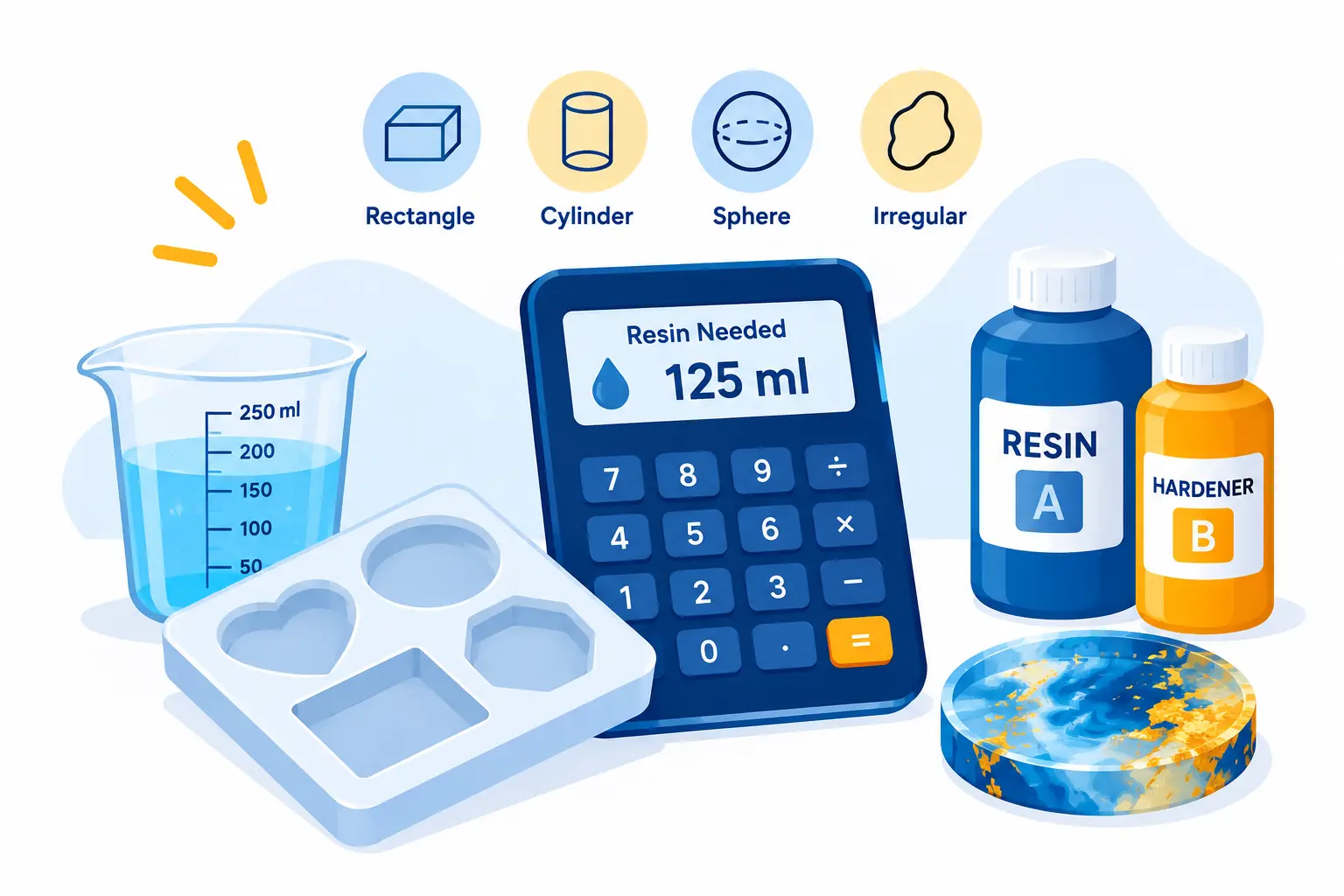
Figuring out the right resin quantity before you mix is the first hurdle every resin artist runs into, and getting it wrong either wastes expensive material or leaves a half-filled, ruined piece. This guide breaks down the exact volume math for every common mold shape, walks through real worked examples, and points you to a free calculator so you never have to guess again.
Why Get This Right — 6 Reasons It Matters
- Stops overfilling and wasted resin
- Prevents sunken, underfilled pieces
- Saves money on expensive epoxy
- Works for any mold shape
- No manual math required with the calculator
- Reduces bubbles from re-pours
Why Guessing Resin Quantity Wastes Money
Epoxy resin isn't cheap, and once Part A and Part B are combined, there's no undoing it. Craft brands and online forums spend a lot of time explaining mixing ratios — how much hardener versus resin — but they rarely explain the step that actually comes first: figuring out the total volume your mold needs before ratios even matter. Get the volume wrong, and the ratio becomes irrelevant. A standard 16 oz (473 ml) craft resin kit typically costs $20 to $40, which works out to roughly $0.04–$0.08 per milliliter — so overpouring by even 100–150 ml on a miscalculated mold can waste $5 to $12 of mixed resin. Once it's combined you're also working against a 30- to 45-minute pot life before it starts to gel in the cup, so there's no pausing partway through to remix.
The Resin Calculation Formula for Every Mold Shape
At its core, this formula is nothing more than basic geometry borrowed from math class. Here's how it breaks down by shape.
1. Rectangular or Square Molds
Since 1 cubic centimeter equals 1 milliliter, measuring in centimeters gives a ready-to-use number. A tray mold measuring 20 cm × 10 cm × 1.5 cm needs 300 ml of mixed resin before any buffer is added.
2. Cylindrical Molds (Coasters, Tumblers, Rounds)
Radius is half the diameter. A coaster mold 10 cm wide (radius 5 cm) and 1 cm deep needs roughly 3.14 × 25 × 1 = 78.5 ml.
3. Spherical Molds
If you're only filling half a sphere mold, divide the final result by two.
4. Irregular Molds (Figurines, Geodes, Custom Shapes)
No formula covers this cleanly, which is where the water displacement method takes over:
- Fill the empty mold cavity completely with water.
- Pour that water into a graduated measuring cup.
- Read the volume — that's your resin quantity.
- Dry the mold thoroughly before pouring actual resin.
Resin for Flat Pours & Canvas Art (No Mold Cavity)
Not every resin project uses a mold with sides — canvas panels, river tables, and tabletop flood coats are flat pours where you're coating a surface rather than filling a cavity, so the math shifts from mold volume to surface coverage.
The craft-resin industry standard for a self-leveling flood coat is roughly 3 fluid ounces (about 90 ml) of mixed resin per square foot at a 1/8-inch (about 3 mm) thickness. Deep-pour river tables use this same area formula but at much greater depth, poured in 2–4 cm layers so each layer reaches its gel point before the next goes on top, rather than as one single deep pour.
How to Calculate Resin in 4 Steps
- Measure the mold cavity. Use the internal dimensions, not the outer silicone edges, and work in centimeters for precision.
- Apply the matching formula for your mold's shape — rectangular, cylinder, sphere, or water displacement for irregular cavities.
- Add a buffer — 10–15% if you're still new to resin, or 5–10% once you've got a few pours of practice — to cover resin that clings to the mixing cup and stir stick.
- Split the total by your resin's mixing ratio — 1:1, 2:1, or 3:1 — to get exact Part A and Part B amounts.
Worked Examples: Putting the Formula to Use
Keychain mold: a cavity 4 cm long, 3 cm wide, and 0.8 cm deep. Using the rectangular formula: 4 × 3 × 0.8 = 9.6 ml. Add a 10% buffer and you're mixing about 10.5 ml total — split according to your resin's ratio.
Canvas flood coat: a 40 cm × 50 cm canvas at a 2 mm coat depth. Area × depth: 40 × 50 × 0.2 = 400 ml. Add a 10% buffer for roughly 440 ml total, poured in one even layer.
River table: a channel 150 cm long and 30 cm wide, poured in a 4 cm deep layer. 150 × 30 × 4 = 18,000 ml (18 liters) for that single layer — deep pours like this are mixed and poured in stages, not all at once, so plan on multiple batches rather than one giant mix.
Reference Table for Common Mold Sizes
| Mold Type | Approx. Internal Size | Estimated Volume |
|---|---|---|
| Small coaster | 10 cm dia. × 0.5 cm | ~39 ml |
| Standard tray | 20 cm × 10 cm × 1.5 cm | ~300 ml |
| Round pendant | 3 cm dia. × 0.5 cm | ~3.5 ml |
| Tabletop river (per foot) | varies by width | area × 0.32 cm depth |
All figures are estimates. Always measure your specific mold — a 5 mm error can waste 10–20 ml of resin.
What Is a Resin Mixing Ratio?
A resin mixing ratio is the proportion of resin (Part A) to hardener (Part B) that a manufacturer specifies for the chemical reaction to cure correctly — commonly 1:1 or 2:1 by volume. This is separate from the volume math covered above, which tells you the total combined amount; the ratio then tells you how to split that total. Most beginner-friendly craft resins use a simple 1:1 ratio, while deep-pour and casting resins typically use 2:1 or 3:1 for slower, cooler curing.
Converting Between Milliliters, Grams, and Ounces
Once you have your mold's volume in milliliters, you may still need to convert that number for a scale or a recipe written in a different unit. Epoxy resin is denser than water, and most craft resins fall between 1.05 and 1.15 grams per milliliter once mixed. That means 100 ml of mixed resin typically weighs about 105 to 115 grams, not exactly 100 grams as many beginners assume. If your mold needs 100 ml, plan on weighing out roughly 105 to 110 grams of combined Part A and Part B on a digital kitchen or jewelry scale.
For those working in fluid ounces instead of milliliters, 1 fluid ounce equals approximately 29.57 ml, so a mold that holds 300 ml needs a little over 10 fluid ounces of resin. Many US-based hobby resin kits are sold in ounces, so this conversion matters when a mold's measurements were taken in centimeters but the resin kit label is printed in imperial units. Keeping a small conversion note next to your measuring cups saves time on every future project.
Scales are generally more reliable than volume-based measuring cups when a resin has a mixing ratio other than 1:1, because pouring "half a cup" of a thicker Part B doesn't guarantee an accurate half by weight. For any 2:1 or 3:1 resin, weighing each part separately on a scale, rather than eyeballing cup lines, produces a far more consistent cure and reduces the risk of a tacky, under-cured surface.
Common Mistakes That Throw the Math Off
- Measuring the outside of the silicone mold instead of the internal cavity — this always overestimates.
- Skipping the buffer — residue on the cup and stir stick eats into your "exact" amount.
- Weighing 1:1 resin on a scale — Part A and Part B often have different densities, so volume measurement is more reliable than weight for equal-ratio resins.
- Using the wrong resin type for depth — deep pours need slow-curing formulas, or the mass overheats and cracks.
Why Trust This Resin Volume Formula
The formulas above aren't specific to any one resin brand — they're standard geometry used across the craft resin industry, from jewelry-making tutorials to industrial mold-making guides. Manufacturer safety data sheets and mixing instructions consistently confirm the same volume-to-weight relationship, with most craft epoxy resins landing in the 1.05–1.15 g/ml density range once mixed. This remains the most widely recommended approach among experienced resin artists, mold makers, and hobby suppliers for avoiding wasted material.
Try the Free Resin Quantity Calculator
If you'd rather not multiply cubic centimeters by hand every time you switch molds, our free tool does this instantly for rectangles, cylinders, spheres, cones, and irregular shapes — including the water displacement calculation. Unlike sites that only cover mixing ratios, it solves the volume question first, which is the step most guides skip.
Try the Free Calculator →Related Calculators & Tools
Frequently Asked Questions
How much resin do I need for a mold?
How much resin you need for a mold depends on its internal volume. Measure the length, width, and depth in centimeters and multiply them together to get milliliters. Add a 5 to 10 percent buffer for spillage and mixing residue. For round or irregular molds, use the cylinder, sphere, or water displacement formula instead of a straight multiplication.
What is the resin calculation formula?
For a rectangular mold, it's Length × Width × Depth, measured in the same unit. For cylinders it's π × radius² × height, and for spheres it's 4/3 × π × radius³. Centimeters convert directly to milliliters, so no extra conversion step is needed.
Is the resin quantity calculator free to use?
Yes, the AgeCalcAI resin quantity calculator is completely free, with no sign-up or hidden cost. Enter your mold's dimensions and shape, and the tool calculates the exact resin volume in milliliters, grams, and ounces instantly.
How do I measure a mold for the calculator?
Measure the internal cavity, not the outer silicone dimensions, since that's the space resin will fill. Use centimeters for accuracy on small pieces. For irregular cavities, use the water displacement method instead of a ruler.
What is the water displacement method for resin molds?
Fill the empty cavity completely with water, then pour it into a graduated measuring cup to read the volume. That reading is the resin quantity needed. It works for any shape, including figurines and geodes where no geometric formula applies.
Does this resin calculator work on mobile?
Yes, it's fully responsive and works on phones, tablets, and desktops without an app download, showing results instantly as you enter your mold's dimensions.
How accurate is this resin formula?
The formula is mathematically exact for regular shapes, since it's based on geometry rather than estimation. Real-world accuracy depends on measurement precision — a 5 mm error can shift the result by 10–20 ml on a mid-sized mold.
What is the standard buffer to add when mixing resin?
Most resin artists add a 5 to 10 percent buffer on top of the calculated volume, to cover resin that sticks to the mixing cup and stir stick during pouring, especially with thicker, higher-viscosity resins.
Can I use this calculator for silicone mold making too?
Yes, the same volume formulas apply to calculating liquid silicone needed for a custom mold — calculate the mold box volume, subtract the object's volume, and the remainder is the silicone required.
Do I need to download anything to use the calculator?
No download is required. The resin quantity calculator runs directly in your browser and doesn't ask for an email address or account creation — just bookmark the page for future projects.
Can beginners use this resin formula?
Yes, it only involves multiplying a few measurements for most shapes. Beginners should use the free calculator instead of manual math, and always measure twice, since mixed resin can't be undone.
Does the calculator save or store my measurements?
No personal data or measurements are stored. Calculations happen instantly in your browser and nothing is saved to a server, making it safe for hobby and commercial resin work alike.
How is the resin to hardener ratio calculated after finding volume?
Once you know the total volume, divide it by your resin's mixing ratio. For 1:1, split it equally. For 2:1, divide the total into three parts, giving two parts resin and one part hardener, always checking the manufacturer's label.
What is the recommended resin depth for a single pour?
Standard tabletop resins are usually rated for pours under a quarter inch (about 6 mm) per layer. Thicker single pours with fast-curing resin risk overheating and cracking — use a deep-pour resin instead for deeper molds.
What makes this resin quantity calculator better than manual math?
It handles multiple mold shapes, including irregular ones via water displacement, and instantly converts between milliliters, grams, and ounces — removing the arithmetic mistakes that can waste expensive resin.
Do I need a different formula for canvas or tabletop pours?
Yes — flat pours use surface area × coating depth instead of a mold-volume formula, since there's no cavity with sides. A typical flood coat runs about 3 fluid ounces of mixed resin per square foot at a 1/8-inch thickness.
What if I mixed too little or too much resin?
If you mixed too little, pour what you have and add a second, thin top-up layer once the first reaches a tacky gel stage — don't add liquid resin to liquid resin. If you mixed too much, pour the extra into a spare mold or silicone tray to make coasters or small pieces rather than wasting it, as long as you use it before it starts to gel.