Checking your dating age gap? Match your sleep schedules too!
Calculate better mornings with the new Wake Up Time Calculator.
Find the Exact Gap Between Two Dates
Couples · Siblings · Friends · Marriage · Official Documents
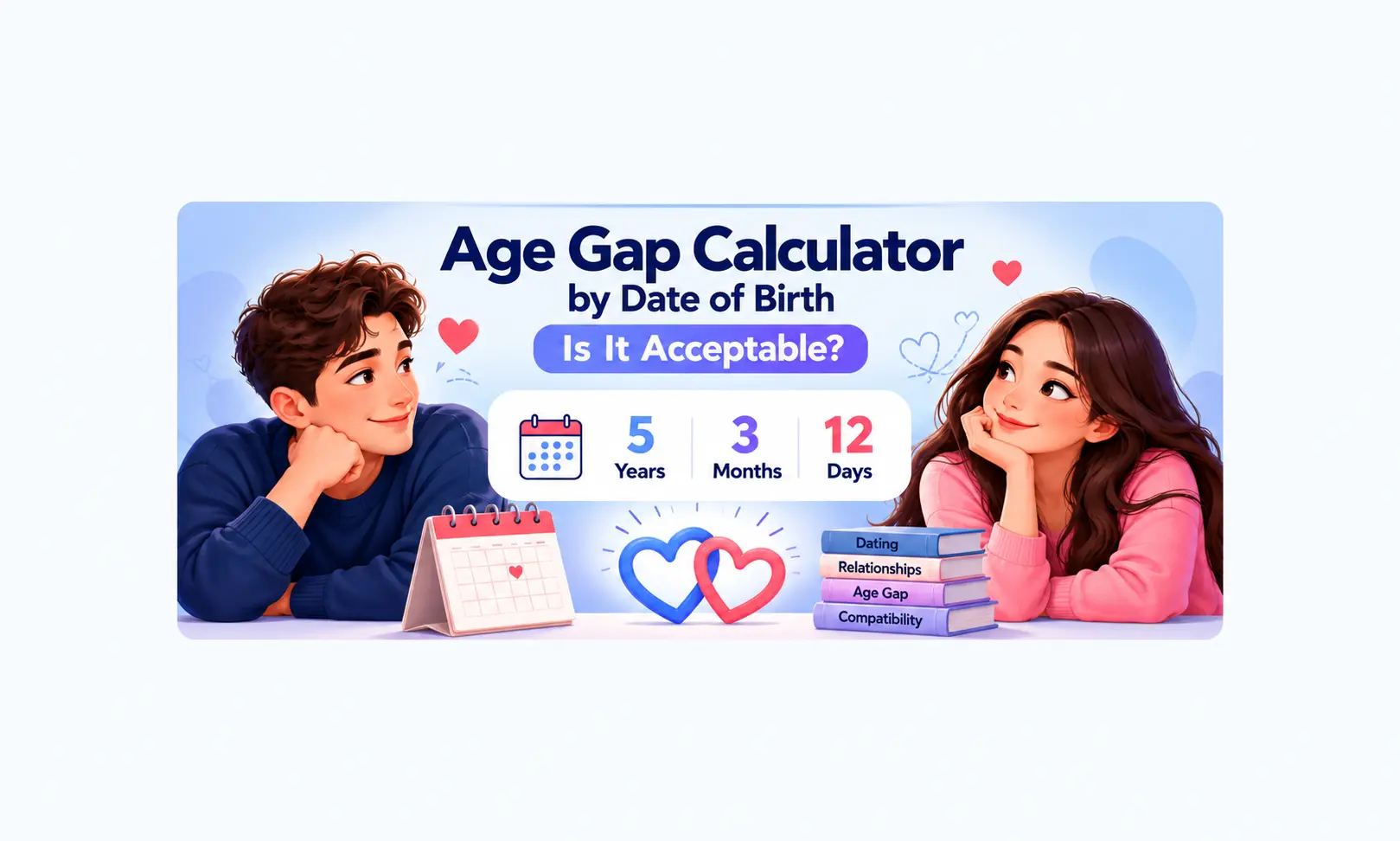
Find the exact gap between two birth dates in years, months, and days. Useful for couples, siblings, friends, job applications, marriage forms, and exam age-eligibility checks.
Quick answer: Enter both birth dates above to get your exact gap in years, months, and days instantly. As a rough guide, gaps under 5 years are generally seen as very comfortable, 5–10 years as workable with mutual understanding, and 15+ years as needing stronger communication and aligned life goals — this is a general social observation, not a rule, and does not account for legal age-of-consent considerations where a minor is involved.
📖How to Use the Age Difference Calculator — 3 Steps
Select Person 1 and Person 2 dates of birth using the date pickers. Switch to "My Own Age" tab to calculate your personal age on any chosen date.
Our free tool instantly finds the exact gap in years, months, and days. No manual math needed — results appear within a second with full accuracy.
Results show who is older, the total days between dates, and a gap insight. You can also click any popular birth year below to auto-calculate instantly.
This tool is built for anyone who needs a quick, accurate result. Whether you are comparing two birth dates for a couple, checking a sibling gap, verifying exam eligibility, or filling out a marriage form, you get a precise figure every time — leap years are handled automatically.
🎯Who Uses This Tool?
This free tool is trusted for many everyday and official uses:
📊Is Your Gap Considered Acceptable? A Quick Reference
A general social guideline for how a gap between two adults is commonly perceived — not a rule, and not legal advice:
| Gap | General Perception |
|---|---|
| 0–2 years | Very small — typically seen as ideal, similar life stage |
| 3–5 years | Small — comfortable and very common |
| 6–10 years | Moderate — generally fine with mutual understanding |
| 11–15 years | Significant — workable with shared values and clear expectations |
| 16+ years | Large — needs strong communication and aligned life goals |
Note: when one person involved is a minor, age-of-consent and statutory laws apply and take priority over any social guideline above — this table reflects general adult-relationship perception only.
✨Why Choose This Free Tool?
📆Popular Birth Year Lookups
Tap any year to instantly calculate your age — our tool fills the date automatically:
❓ Frequently Asked Questions
1. What is the 7 year rule for dating?
The 7 year rule for dating is colloquially known as the "half your age plus seven rule". It is an unwritten societal rule used to work out a socially acceptable gap. You divide your age by two and add seven to find the minimum age of a dating partner. You can check this mathematically using the calculator above.
2. How to calculate age gap dating?
Simply input the exact date of birth of both partners above. The tool uses the standard formula to instantly show the exact duration in years, months, and days.
3. Is 18 and 20 a bad age gap?
No, a gap between 18 and 20 is mathematically only 2 years, which is extremely common and generally considered very acceptable. With just 2 years of separation, both individuals are usually in similar life stages.
4. Is 15 and 18 a bad age gap?
Mathematically this is a 3-year gap. But at these specific ages, one partner is a minor — age-of-consent and statutory laws vary by country and state, and relationships involving a minor carry legal considerations that a simple year-gap number does not capture. This calculator shows the mathematical difference only; it is not legal guidance.
5. Is a 20 year age gap too much for a couple?
A 20 year age gap is considered significant. While relationships can work at any gap, partners are usually in very different life stages 20 years apart. Strong communication and shared life goals matter more here than at smaller gaps.
6. Is a 15 year age difference too much?
A 15 year gap falls into the 'moderate to large' range. Mathematically, the older partner has almost half a generation of extra life experience. It is workable as long as both adults have mutual respect, similar goals, and clear expectations.