How to Use This Height Comparison Tool
You can build a clean chart in about a minute. Follow these five steps and you will not need any other app.
- Pick your unitChoose ft & in or cm above the chart. You can switch whenever you like, and every height converts on its own.
- Add people and objectsTap Man, Woman or Child, or choose an object such as a standard door, a basketball rim or the Statue of Liberty. Prefer a photo or a drawing? Upload an image and it scales to the height you type.
- Type each heightFill in the feet and inches (or centimeters) for every figure. The chart updates as you type, and a short message appears if a number does not make sense.
- Read the gapThe Height difference box compares everyone with the figure you choose. Click any figure to make it the reference. Drag figures, or use the arrow buttons, to change their order.
- Download or shareSave the chart as a PNG, copy a link that reopens the same chart, or copy the embed code for your own page.
What Is a Height Comparison Chart?
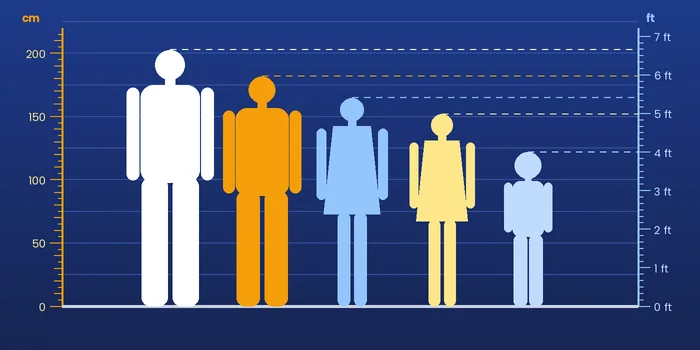
Height comparison chart: a picture that stands people or objects side by side on one vertical scale, so a difference in height shows up as a difference in size. It answers “how much taller?” at a glance.
A height scale comparison is just another name for putting everything on the same ruler. That shared ruler is the whole point. The numbers 5′ 4″ and 5′ 9″ tell you the gap is five inches, but your brain still has to picture it. A chart does the picturing for you.
People use these charts for couples and wedding photos, character design, sports, classroom projects and furniture planning. A chart is only as accurate as the heights you enter, so the measuring tips further down are worth two minutes of your time.
Height Comparison in Feet, Inches and Centimeters
The United States measures height in feet and inches. Most other countries use centimeters. This tool shows both on the same chart, with centimeters (or meters) on the left ruler and feet on the right.
Every conversion rests on one exact fact: 1 inch is 2.54 centimeters by definition, and 1 foot is 12 inches, or 30.48 centimeters.
centimeters = total inches × 2.54
inches = centimeters ÷ 2.54
Here is a quick example. Take 175 cm. Divide by 2.54 and you get 68.9 inches. Divide 68.9 by 12 and you get 5 feet with 8.9 inches left over, so 175 cm is 5′ 8.9″.
| Height | Total inches | Centimeters |
|---|---|---|
| 5′ 0″ | 60 | 152.4 |
| 5′ 1″ | 61 | 154.9 |
| 5′ 2″ | 62 | 157.5 |
| 5′ 3″ | 63 | 160.0 |
| 5′ 4″ | 64 | 162.6 |
| 5′ 5″ | 65 | 165.1 |
| 5′ 6″ | 66 | 167.6 |
| 5′ 7″ | 67 | 170.2 |
| 5′ 8″ | 68 | 172.7 |
| 5′ 9″ | 69 | 175.3 |
| 5′ 10″ | 70 | 177.8 |
| 5′ 11″ | 71 | 180.3 |
| 6′ 0″ | 72 | 182.9 |
| 6′ 1″ | 73 | 185.4 |
| 6′ 2″ | 74 | 188.0 |
| 6′ 3″ | 75 | 190.5 |
| 6′ 4″ | 76 | 193.0 |
| 6′ 5″ | 77 | 195.6 |
| 6′ 6″ | 78 | 198.1 |
Need other units, such as kilograms or miles? Our unit converter for length, weight and temperature covers them.
How to Calculate a Height Difference
The difference between two heights is the taller one minus the shorter one, as long as both use the same unit. With centimeters it is plain subtraction: 185 cm − 168 cm = 17 cm, which is about 6.7 inches.
Feet and inches need one extra step, because inches roll over at 12. Convert both heights to inches, subtract, then turn the answer back into feet and inches. For example, 6′ 1″ is 73 inches and 5′ 8″ is 68 inches, so the gap is 5 inches.
percent taller = difference ÷ shorter height × 100
Using the same pair, 5 ÷ 68 is about 7.4%, so the taller person is roughly 7.4% taller. The tool shows this percentage for everyone you compare. You can check any figure with our percentage calculator.
Comparing people instead of heights? The age difference calculator does the same kind of subtraction for birthdays.
Common Height Differences Between Couples
Couples are one of the most common reasons people run a height comparison, so here are the gaps for some typical U.S. pairings. Each row is simple arithmetic on inches, then converted to centimeters.
| Shorter | Taller | Gap (in) | Gap (cm) | Taller by |
|---|---|---|---|---|
| 5′ 2″ | 5′ 10″ | 8 in | 20.3 cm | 12.9% |
| 5′ 2″ | 6′ 0″ | 10 in | 25.4 cm | 16.1% |
| 5′ 2″ | 6′ 2″ | 12 in | 30.5 cm | 19.4% |
| 5′ 4″ | 5′ 10″ | 6 in | 15.2 cm | 9.4% |
| 5′ 4″ | 6′ 0″ | 8 in | 20.3 cm | 12.5% |
| 5′ 4″ | 6′ 2″ | 10 in | 25.4 cm | 15.6% |
| 5′ 6″ | 5′ 10″ | 4 in | 10.2 cm | 6.1% |
| 5′ 6″ | 6′ 0″ | 6 in | 15.2 cm | 9.1% |
| 5′ 6″ | 6′ 2″ | 8 in | 20.3 cm | 12.1% |
For context, CDC measurements put the average gap between U.S. men and women at about 5.4 inches (13.7 cm). To recreate any row, type both heights into the tool and click a figure to choose who you compare against.
Average Height in the United States
The CDC’s National Center for Health Statistics reports measured average heights for U.S. adults aged 20 and older: 68.9 inches (175.0 cm) for men and 63.5 inches (161.3 cm) for women. Those figures come from its August 2021–August 2023 data and work out to 5′ 8.9″ and 5′ 3.5″. You can read the numbers on the CDC body measurements page.
These are averages of measured heights, not self-reported ones, and they describe the whole adult population. Individual people vary a lot, so use them as a yardstick, not a target. Load the U.S. average man and woman preset above to see both figures side by side, then add yourself.
Reference Objects, Landmarks and World Records
Objects give a height comparison a sense of scale. Add a door, a rim or a landmark next to your own figure and the numbers suddenly mean something.
| Item | Height | Centimeters |
|---|---|---|
| Chandra Bahadur Dangi (shortest adult ever verified) | 1′ 9.5″ | 54.6 |
| U.S. average woman, age 20+ (CDC) | 5′ 3.5″ | 161.3 |
| U.S. average man, age 20+ (CDC) | 5′ 8.9″ | 175.0 |
| Standard U.S. interior door | 6′ 8″ | 203.2 |
| Robert Wadlow (tallest man ever) | 8′ 11.1″ | 272.0 |
| Basketball rim | 10′ 0″ | 304.8 |
| Statue of Liberty (ground to torch tip) | 305′ 1″ | 9,299 (92.99 m) |
Two rows come from Guinness World Records. Robert Wadlow, the tallest man in medical history, measured 2.72 m (8 ft 11.1 in) in June 1940. Chandra Bahadur Dangi, the shortest adult ever verified, measured 54.6 cm (21.5 in) in 2012. The gap between them is 217.4 cm, or 7 ft 1.6 in, and Wadlow was almost five times as tall.
Scale can surprise you. The National Park Service lists the Statue of Liberty at 305 ft 1 in from the ground to the tip of the torch. A 5′ 10″ person is only about 1.9% of that height. Try the Statue of Liberty preset and watch the person nearly disappear. For a friendlier example, a 6′ 0″ player stands 4 ft below a 10 ft basketball rim.
How to Measure Your Height Accurately at Home
A chart looks convincing even when the numbers are off, so measure carefully before you start a height comparison. Here is a simple method that needs one helper.
- Take off your shoes, hats and hair accessories.
- Stand with your heels, hips and shoulder blades against a flat wall. Look straight ahead with your chin level.
- Ask your helper to hold a flat, hard object, such as a hardcover book, on top of your head against the wall and mark the spot.
- Measure from the floor to the mark with a rigid tape, then repeat once and use the average.
Measure at the same time of day for everyone. The discs in your spine compress as you stand and walk, so you are a little shorter in the evening than in the morning. One study of spinal discs reports a daily loss of up to about 2 cm, roughly 1% of body height, which returns overnight. If two people measure at different hours, part of the gap may come from timing.
Common Mistakes When Comparing Heights
A few small slips can throw off any height comparison. Watch for these.
- Mixing decimal feet with feet and inches. Typing 5.9 into the inches box is a classic slip. 5.9 ft is actually 5′ 10.8″, not 5′ 9″.
- Comparing shoes on with shoes off. Keep every measurement barefoot, or every measurement in the same shoes.
- Trusting listed celebrity heights. Published heights for public figures are often rounded, self-reported or measured in shoes, so treat them as estimates.
- Judging height from photos. The closer someone stands to a camera, the taller they look. A chart avoids that distortion.
- Expecting the silhouettes to match real bodies. The figures use one generic shape scaled to height. They show height, not build.
Who Uses a Height Comparison Tool?
Couples and wedding parties
Line up the wedding party by height before the photographer does. If the big day is coming up, our wedding countdown keeps the date in sight, and the wedding hashtag generator helps with names.
Writers, artists and game designers
Keep character heights consistent across chapters, panels and levels. Add a door or a rim as a fixed reference and your characters always stay in proportion to the world around them.
Sports fans
Compare a player with a basketball rim, or line up a whole team against the average U.S. adult.
Home and design planning
Check a door, shelf or counter against the people who use it. For floor space, the room area calculator is a good next step.
Parents and teachers
Charts make a fun classroom or family project. Children grow at different rates, and this tool does not assess growth. If you have concerns about a child’s growth, talk to a pediatrician.
What This Height Comparison Tool Can Do
One shared scale
Every figure stands on the same baseline, so the gaps are proportional and never decorative.
Two rulers at once
Centimeters or meters on the left, feet on the right, with ticks that adapt to the tallest item.
Up to 50 items
Compare a couple, a family or a whole team. Objects can be as tall as 10 km.
Drag, click or use arrows
Reorder figures by dragging, or with the arrow buttons and keyboard keys.
Exact differences
See the gap in feet, inches and centimeters, plus the percentage, for everyone you compare.
Your own images
Upload a photo or drawing and it scales to the height you type.
PNG, link and embed
Download the chart, copy a link that reopens it, or embed it on your site.
Private by design
The chart is drawn in your browser and needs no account.
What to Look for in a Height Comparison Website
Not every height comparison website is built the same. Before you trust one, check these points:
- One shared scale. Figures should be proportional to the numbers you type.
- Both unit systems. You should never need a second tool to convert.
- Exact numbers next to the picture. A chart without the actual difference leaves you guessing.
- Export and sharing. A PNG or link saves you from screenshots.
- No signup and clear privacy. A chart should not need an account.
- Honest data. Sources for any preset heights should be visible.
We built this page to tick each box, and we list the sources for every preset on this page.
Privacy and How the Tool Works
Your height comparison is drawn in your browser. We do not upload or store the heights, names or images you enter. To make your last chart reappear next time, the tool saves it in your browser’s local storage, and the Reset button clears it. Uploaded images are never saved or added to share links. Site-wide analytics and advertising are described in our privacy policy.
Height Comparison FAQ
How do I compare heights online with this tool?
Choose your unit, add a man, woman, child, object or image, and type each height. The chart redraws as you type. Click a figure to compare everyone against it, then download the PNG or copy a link.
How much taller is 5′ 9″ than 5′ 4″?
It is 5 inches (12.7 cm). 5′ 9″ is 69 inches and 5′ 4″ is 64 inches, so the taller person is about 7.8% taller than the shorter one.
Is 5′ 3″ vs 5′ 7″ a big height difference?
It is a 4-inch gap (10.2 cm), or about 6.3% of the shorter height. That is smaller than the roughly 5.4-inch average gap between U.S. men and women reported by the CDC, so it is a noticeable but very ordinary difference.
What is a height scale comparison?
It is another name for a height comparison: everyone is drawn against the same ruler, so sizes are directly comparable. This tool shows centimeters or meters on the left ruler and feet on the right.
How accurate is this height comparison chart?
Figures are drawn to scale, and the numbers under each figure are exactly what you typed. Heights are stored in centimeters and converted with 1 inch = 2.54 cm. The silhouettes are generic, so they show height, not body build, and the result is only as accurate as your measurements.
Can I compare more than two people?
Yes. Add up to 50 figures on one chart. On small screens a wide chart scrolls sideways, and you can reorder figures by dragging them or with the arrow buttons.
Can I compare a person with an object or a building?
Yes. Pick a standard door, a basketball rim or the Statue of Liberty, or add a custom object with any height up to 10 km. If a tall object shrinks the people, turn on Zoom to people.
Can I upload my own image?
Yes. Upload a PNG, JPG, WebP or GIF up to 8 MB and it scales to the height you type. The image stays in your browser. It is not saved and not included in share links.
How do I convert centimeters to feet and inches?
Divide the centimeters by 2.54 to get inches, then divide by 12 for feet and keep the remainder. For example, 175 cm is 68.9 inches, or 5′ 8.9″. For other units, try the unit converter.
How do I calculate the height difference between two people?
Convert both heights to the same unit and subtract the shorter from the taller. For 6′ 1″ (73 in) and 5′ 8″ (68 in) the gap is 5 inches. Divide by the shorter height for a percentage: 5 ÷ 68 is about 7.4%.
Does the height comparison tool work on my phone?
Yes. The layout adapts to small screens, buttons and inputs are sized for touch, and you can drag figures with a finger. Wide charts scroll sideways.
How do I download or share my chart?
Use Download PNG to save the chart, Copy link to reopen the same chart later, or Embed to get code for your own page. Links store heights, names and colors in the URL, but not uploaded images. The PNG carries a small AgeCalcAI credit line at the bottom.
What is the average height in the United States?
The CDC reports measured averages for U.S. adults aged 20 and older of 68.9 inches (175.0 cm) for men and 63.5 inches (161.3 cm) for women, from its August 2021–August 2023 data.
Are my heights stored or uploaded anywhere?
No uploads happen. The chart is drawn in your browser, and your last chart is kept in your browser’s local storage so it reappears next time. The Reset button clears it, and uploaded images are never saved.
How much taller was the tallest man ever than the shortest?
Guinness World Records lists Robert Wadlow at 272 cm (8′ 11.1″) and Chandra Bahadur Dangi at 54.6 cm (1′ 9.5″). The difference is 217.4 cm, or 7 ft 1.6 in.
Sources
- CDC National Center for Health Statistics: body measurements (average U.S. adult height)
- Guinness World Records: tallest man ever (Robert Wadlow)
- Guinness World Records: shortest man ever (Chandra Bahadur Dangi)
- National Park Service: Statue of Liberty National Monument
- PubMed Central: daily changes in intervertebral discs and spinal height
More Free Tools on AgeCalcAI
Last updated:
Disclaimer: This tool compares heights visually and gives general information. It does not measure anyone’s height, assess growth or give medical advice. Silhouettes are generic and object heights are approximate. For growth or health concerns, talk to a qualified healthcare professional. Read the full disclaimer.
Ready to Compare Heights?
Add your heights, read the gap and download the chart. It is free and takes a minute.
Open the chart maker