 AgeCalcAI
Half Your Age Plus 7 Calculator: Check the Half Your Age Plus Seven Rule
Quick answerThe half your age plus 7 rule says the youngest person you should date is half your age plus seven years, and the oldest is your age minus seven, doubled. At 30, that range runs from 22 to 46. The rule comes from a 1901 book, so it’s a rule of thumb, not a law.
Enter your age to see the youngest and oldest partner age the rule allows, or test whether two ages fit.
- Free
- No sign-up
- The math runs in your browser
- Adults 18 and older
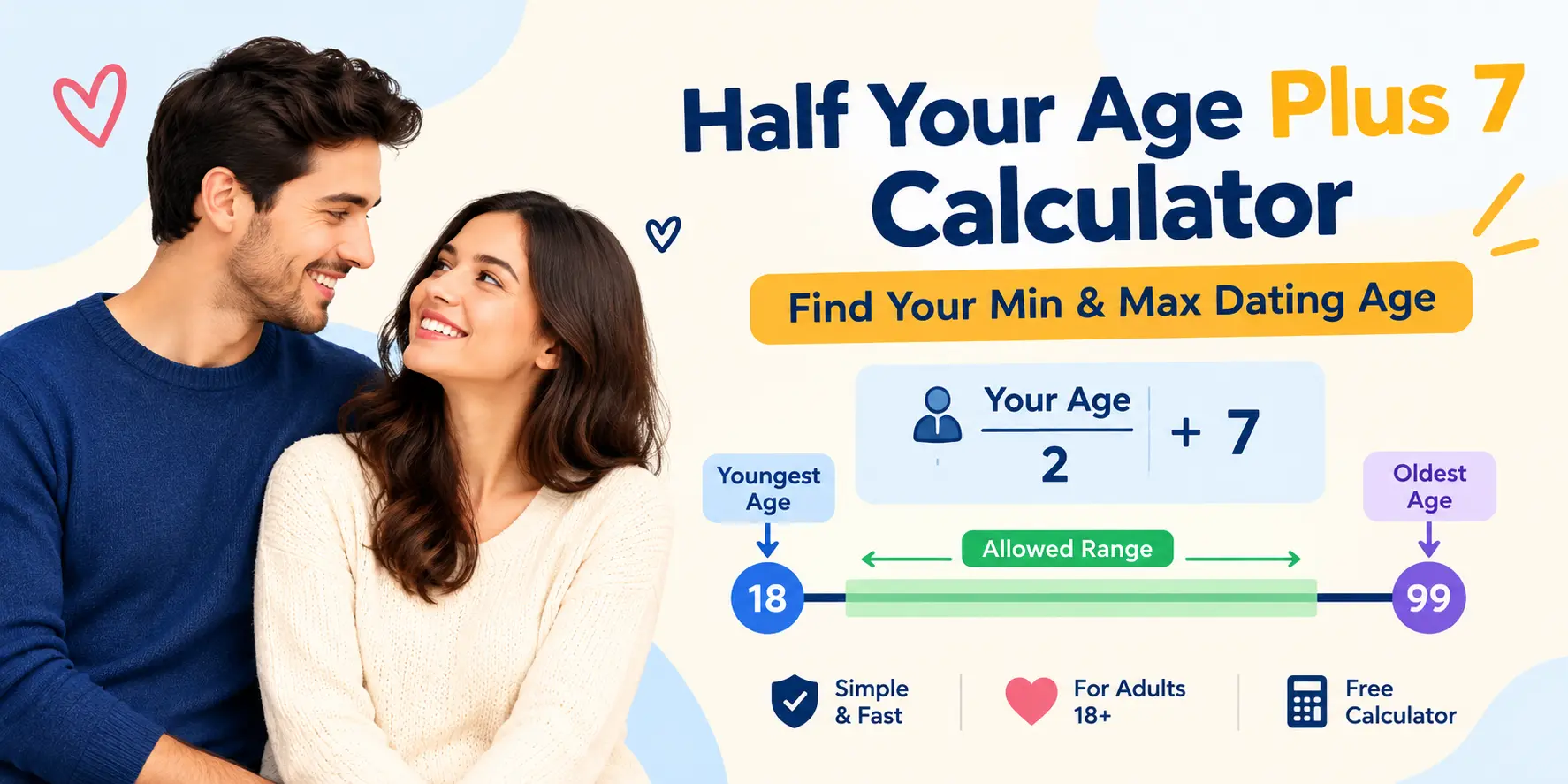
Calculate your range
Type an age to see the youngest and oldest partner age under the rule.
Enter both ages to see whether the pair fits the rule.
The shaded band shows the ages the older person’s range covers. For exact birthdays, use the age difference calculator.
How the Half Your Age Plus 7 Rule Works
The half your age plus 7 rule is two short formulas. One finds the youngest partner age. The other finds the oldest.
(your age ÷ 2) + 7(your age − 7) × 2Both formulas describe one limit from two sides. The first asks who is too young for you. The second asks who would find you too young. When you test a couple, both questions give the same answer, so one check covers both people.
Odd ages create a half. A 25-year-old gets a raw minimum of 19.5. This calculator rounds that up to 20, so a result never sits below the rule. The maximum always comes out as a whole number, so it never needs rounding.
The minimum formula also follows the older person’s age. In any pair, halve the older partner’s age, never the younger one’s.
Age Rule for Dating: Other Names and Wordings
People search for this idea under many names. You’ll hear it called the age rule for dating, the age of dating rule, the rule for dating age, or the half plus seven rule. They all point to the same math.
The wording shifts too. Some people write half your age plus 7 as “half age plus 7” or “half age plus seven.” Others say “half plus 7,” “half plus seven” or “half the age plus 7.” In plain arithmetic it’s age divided by 2 plus 7, and the shortest spoken version is “divide by 2 add 7.”
As an age dating equation, the minimum fits on one line: youngest partner = age ÷ 2 + 7. The age for dating formula in the other direction is: oldest partner = (age − 7) × 2.
Watch the order of operations, though. Searches like “age plus 7 divided 2” usually mean half your age plus 7, but read literally they mean (age + 7) ÷ 2, and that gives a different answer. For a 30-year-old, (30 + 7) ÷ 2 is 18.5, while 30 ÷ 2 + 7 is 22. Divide first, then add.
Worked Examples
Here are four ages run through the half your age plus 7 formula by hand, so you can check the calculator against the math.
- Age 25: 25 ÷ 2 = 12.5, plus 7 is 19.5, which rounds up to 20. The maximum is (25 − 7) × 2 = 36. Range: 20 to 36.
- Age 30: 30 ÷ 2 = 15, plus 7 is 22. The maximum is (30 − 7) × 2 = 46. Range: 22 to 46.
- Age 40: 40 ÷ 2 = 20, plus 7 is 27. The maximum is (40 − 7) × 2 = 66. Range: 27 to 66.
- Age 55: 55 ÷ 2 = 27.5, plus 7 is 34.5, which rounds up to 35. The maximum is (55 − 7) × 2 = 96. Range: 35 to 96.
Now a pair under the half your age plus 7 rule. Take a 32-year-old and a 24-year-old. The floor for 32 is 32 ÷ 2 + 7 = 23, and 24 clears it. Run it backward and the ceiling for a 24-year-old is (24 − 7) × 2 = 34, which is above 32. The pair fits.
A 42-year-old and a 26-year-old don’t fit. The floor for 42 is 28, and 26 sits under it. From the other side, the ceiling for a 26-year-old is 38, and 42 is over it.
Why This Calculator Starts at 18
Run the half your age plus 7 formula on a 19-year-old and the minimum comes out at 16.5. For an 18-year-old it comes out at 16. In fact the raw minimum stays under 18 for everyone younger than 22, because 22 ÷ 2 + 7 is exactly 18.
A dating rule that hands adults a teenager as an acceptable partner isn’t something to publish. So this tool covers adults only. When the raw minimum falls under 18, it shows 18 and explains why in a note.
The half your age plus 7 formula also carries no legal weight. In the United States, each state sets its own age of consent, and it falls between 16 and 18. Some states add conditions about the age gap between partners, as the federal guide to state statutory rape laws explains. If you need to know what’s legal, check the law where you live. This page isn’t legal advice.
Half Your Age Plus Seven Chart: Ages 18 to 80
This half your age plus 7 chart lists the range for every adult age from 18 to 80. The last two columns show something most charts skip: how many years younger and older than you the rule reaches.
| Your age | Youngest partner | Oldest partner | Years younger it reaches | Years older it reaches |
|---|---|---|---|---|
| 18 | 18* | 22 | 0 | 4 |
| 19 | 18* | 24 | 1 | 5 |
| 20 | 18* | 26 | 2 | 6 |
| 21 | 18* | 28 | 3 | 7 |
| 22 | 18 | 30 | 4 | 8 |
| 23 | 19 | 32 | 4 | 9 |
| 24 | 19 | 34 | 5 | 10 |
| 25 | 20 | 36 | 5 | 11 |
| 26 | 20 | 38 | 6 | 12 |
| 27 | 21 | 40 | 6 | 13 |
| 28 | 21 | 42 | 7 | 14 |
| 29 | 22 | 44 | 7 | 15 |
| 30 | 22 | 46 | 8 | 16 |
| 31 | 23 | 48 | 8 | 17 |
| 32 | 23 | 50 | 9 | 18 |
| 33 | 24 | 52 | 9 | 19 |
| 34 | 24 | 54 | 10 | 20 |
| 35 | 25 | 56 | 10 | 21 |
| 36 | 25 | 58 | 11 | 22 |
| 37 | 26 | 60 | 11 | 23 |
| 38 | 26 | 62 | 12 | 24 |
| 39 | 27 | 64 | 12 | 25 |
| 40 | 27 | 66 | 13 | 26 |
| 41 | 28 | 68 | 13 | 27 |
| 42 | 28 | 70 | 14 | 28 |
| 43 | 29 | 72 | 14 | 29 |
| 44 | 29 | 74 | 15 | 30 |
| 45 | 30 | 76 | 15 | 31 |
| 46 | 30 | 78 | 16 | 32 |
| 47 | 31 | 80 | 16 | 33 |
| 48 | 31 | 82 | 17 | 34 |
| 49 | 32 | 84 | 17 | 35 |
| 50 | 32 | 86 | 18 | 36 |
| 51 | 33 | 88 | 18 | 37 |
| 52 | 33 | 90 | 19 | 38 |
| 53 | 34 | 92 | 19 | 39 |
| 54 | 34 | 94 | 20 | 40 |
| 55 | 35 | 96 | 20 | 41 |
| 56 | 35 | 98 | 21 | 42 |
| 57 | 36 | 100 | 21 | 43 |
| 58 | 36 | 102 | 22 | 44 |
| 59 | 37 | 104 | 22 | 45 |
| 60 | 37 | 106 | 23 | 46 |
| 61 | 38 | 108 | 23 | 47 |
| 62 | 38 | 110 | 24 | 48 |
| 63 | 39 | 112 | 24 | 49 |
| 64 | 39 | 114 | 25 | 50 |
| 65 | 40 | 116 | 25 | 51 |
| 66 | 40 | 118 | 26 | 52 |
| 67 | 41 | 120 | 26 | 53 |
| 68 | 41 | 120† | 27 | 52 |
| 69 | 42 | 120† | 27 | 51 |
| 70 | 42 | 120† | 28 | 50 |
| 71 | 43 | 120† | 28 | 49 |
| 72 | 43 | 120† | 29 | 48 |
| 73 | 44 | 120† | 29 | 47 |
| 74 | 44 | 120† | 30 | 46 |
| 75 | 45 | 120† | 30 | 45 |
| 76 | 45 | 120† | 31 | 44 |
| 77 | 46 | 120† | 31 | 43 |
| 78 | 46 | 120† | 32 | 42 |
| 79 | 47 | 120† | 32 | 41 |
| 80 | 47 | 120† | 33 | 40 |
* The raw formula gives a minimum under 18, so the calculator shows 18. † The raw maximum is above 120, so the calculator caps it at 120.
A few patterns stand out. The half your age plus 7 rule first allows a 10-year gap below you at age 34, and a 20-year gap at age 54. From the younger side the reach is bigger: at 30 the oldest partner is 46, which is 16 years above you. And because the window grows with age, a gap means different things at different ages. At 24 the floor sits 5 years below you. At 54 it sits 20 years below.
Does the Rule Work Both Ways?
Yes, the half your age plus 7 rule works both ways, and the math is neat. Take a 36-year-old and a 25-year-old. The floor for 36 is 36 ÷ 2 + 7 = 25, so the 25-year-old sits exactly on the line. Now flip it. The ceiling for a 25-year-old is (25 − 7) × 2 = 36, and the 36-year-old sits exactly on that line too.
That isn’t a coincidence. The two formulas in the half your age plus seven rule are inverses of each other. If the younger person is at or above the older person’s floor, the older person is at or below the younger person’s ceiling. The “Check two ages” tab uses this to give one verdict for the pair.
Where the Rule Came From
Most sources trace the half your age plus 7 formula to Max O’Rell, the pen name of the French writer Léon Paul Blouet. In his 1901 book Her Royal Highness Woman and His Majesty Cupid, it described the ideal age of a bride: half the groom’s age, plus seven. It wasn’t a minimum. It was marriage advice aimed at men, as Dictionary.com explains.
The half your age plus 7 rule then spread through pop culture. Dictionary.com notes that entertainer Maurice Chevalier mentioned it in a 1931 interview, and that the 1951 play The Moon Is Blue referenced it before a 1953 film version. In 2007 the webcomic xkcd gave it the nickname “Standard Creepiness Rule,” and the name stuck.
Along the way the meaning flipped. An “ideal bride age for men” became a “minimum age for anyone.” The half your age plus seven formula didn’t change. The way people use it did.
Is the Half Your Age Plus 7 Rule Accurate?
If accurate means tested, no. Nothing about the half your age plus 7 formula comes from research. It’s a rule of thumb that survived because the math is easy and the results look reasonable at first glance.
Researchers study a different question: which partner ages do people say they’d accept? One widely cited example is a 2001 study by Bram Buunk, Pieternel Dijkstra, Douglas Kenrick and Astrid Warntjes, published in Evolution and Human Behavior. The team asked people aged 20, 30, 40, 50 and 60 for the youngest and oldest partner ages they’d accept at several levels of involvement, from marriage to falling in love.
Women in that study preferred partners around their own age at every age and every level of involvement. Men’s preferences depended on the kind of relationship. That’s more varied than one formula suggests.
Keep the limits in mind. The study measured stated preferences, and it wasn’t designed to test the formula. Don’t read it as a verdict on the rule either way. If you see the paper cited with a different year or journal elsewhere, check the journal record: it lists 2001, volume 22, pages 241 to 250.
Where the Formula Breaks Down
- It ignores everything except age. Life stage, values, and any imbalance of power between two people, such as a boss and an employee, never enter the formula.
- It scales with age. At 24 the floor sits 5 years below you. At 54 it sits 20 years below.
- The maximum runs away at higher ages. At 68 the raw maximum is 122, and at 80 it’s 146. This calculator caps results at 120.
- It says nothing about the law. No formula can tell you whether something is legal.
Use the half your age plus 7 rule as a conversation starter or a quick sanity check, not as a decision.
Common Mistakes When Using the Rule
- Halving the younger person’s age. The minimum formula starts from the older person’s age. If you’re 25 and checking a 40-year-old, halve 40, not 25. The floor is 27, so you’d fall short.
- Rounding down. A 25-year-old’s raw minimum is 19.5, so 19 sits just outside the rule. Round up.
- Reading the range as permission. The half your age plus 7 rule sets a social boundary. It isn’t legal or ethical clearance.
- Trusting raw numbers for young adults. Below age 22 the formula returns minimums under 18. This tool shows 18 instead.
Rule of Thumb or Exact Age Gap?
This half your age plus seven calculator answers one question: does an age fit inside the half your age plus 7 rule? It doesn’t measure how far apart two birthdays are. For that, use the age difference calculator, which returns the exact gap in years, months and days from two dates of birth. To find your own exact age first, try the age calculator.
If you’re curious about time rather than age, the time between dates calculator and the how long ago was tool cover that.
How to Use This Calculator
- Choose a tab. Pick “My age range” to see who fits your age, or “Check two ages” to test a specific pair.
- Enter whole-number ages. Type ages in whole years from 18 to 120. Results update as you type, so there is no button to press.
- Read the range or the verdict. The youngest and oldest partner ages appear with the math shown. In pair mode you get an inside or outside verdict.
- Compare against the chart. Scroll to the reference chart to see the range for any age from 18 to 80, plus how many years younger and older it reaches.
- Treat it as a rule of thumb. The half your age plus 7 rule is a social guideline. It is not a law and it does not measure compatibility.
Frequently Asked Questions
What is the half your age plus 7 rule?
The half your age plus 7 rule is a dating guideline. It says the youngest person you should date is half your age plus seven years. Reverse it and you get the oldest: your age minus seven, doubled. It is an informal social convention, not a law, and nothing shows it predicts how a relationship will go.
What is the youngest a 30-year-old should date under the rule?
Half of 30 is 15, and 15 plus 7 is 22. The rule puts the floor at 22 for a 30-year-old. The reverse formula gives the ceiling: (30 − 7) × 2 = 46. So the full range under the rule is 22 to 46.
How do I find the maximum age with the half your age plus seven rule?
Subtract 7 from your age, then double the result. At 28 that is (28 − 7) × 2 = 42. The maximum formula is the minimum formula run backward: a 42-year-old’s floor is 28, so a 28-year-old sits exactly on the edge.
Does the half your age plus 7 rule work both ways?
Yes. The two formulas are inverses, so a pair passes from one person’s side only if it passes from the other’s. If the younger person clears the older person’s floor, the older person is automatically under the younger person’s ceiling.
Is the half your age plus 7 rule accurate or scientific?
No. It is a rule of thumb from a 1901 book on marriage. Research on real preferences, such as the 2001 Buunk, Dijkstra, Kenrick and Warntjes paper, finds that stated age preferences vary by gender and relationship type, which one formula cannot capture.
Where did the half your age plus seven rule come from?
The French writer Max O’Rell (Léon Paul Blouet) included it in his 1901 book Her Royal Highness Woman and His Majesty Cupid as the ideal age of a bride. Over the 20th century it turned into a minimum-age guideline for anyone, helped along by pop culture.
Is the half your age plus 7 rule a law, and does it override age of consent?
No. The rule has no legal standing. In the United States each state sets its own age of consent, between 16 and 18, and some states add conditions about age gaps. A formula cannot tell you what is legal where you live, so check your local law.
Why does this calculator start at 18?
The raw formula returns a minimum under 18 for anyone younger than 22. It gives 16 for an 18-year-old, for example. This tool is for adults only, so it never shows a partner range below 18 and tells you when the formula would have.
Does the half your age plus 7 rule apply to same-sex couples?
The formula is plain arithmetic, so it does not care about gender. The 1901 wording was advice for men choosing wives, but people now use it as an informal benchmark for any couple. It is still a rule of thumb, not a standard.
At what age does the half your age plus 7 rule stop making sense?
Because the rule scales with your age, the numbers get loose as you get older. It first allows a 10-year gap at 34 and a 20-year gap at 54. At 68 the maximum formula returns 122, so this calculator caps results at 120.
What is the standard creepiness rule?
It is the nickname the webcomic xkcd gave the half your age plus seven rule in 2007. The name spread online as a joke and refers to the same formula.