Days Until Daylight Saving Time Ends
A live, real-time countdown to the moment clocks fall back one hour in the United States. Free, accurate, updates every second.
Last Updated: September 13, 2026
- Daylight Saving Time ends Sunday, November 1, 2026, at 2:00 AM local time
- Clocks "fall back" one hour to 1:00 AM, giving most Americans an extra hour of sleep
- Applies to most of the US, Canada, and Mexico - not Hawaii or most of Arizona
- DST starts again on Sunday, March 14, 2027
- Countdown below updates live based on your device's local time
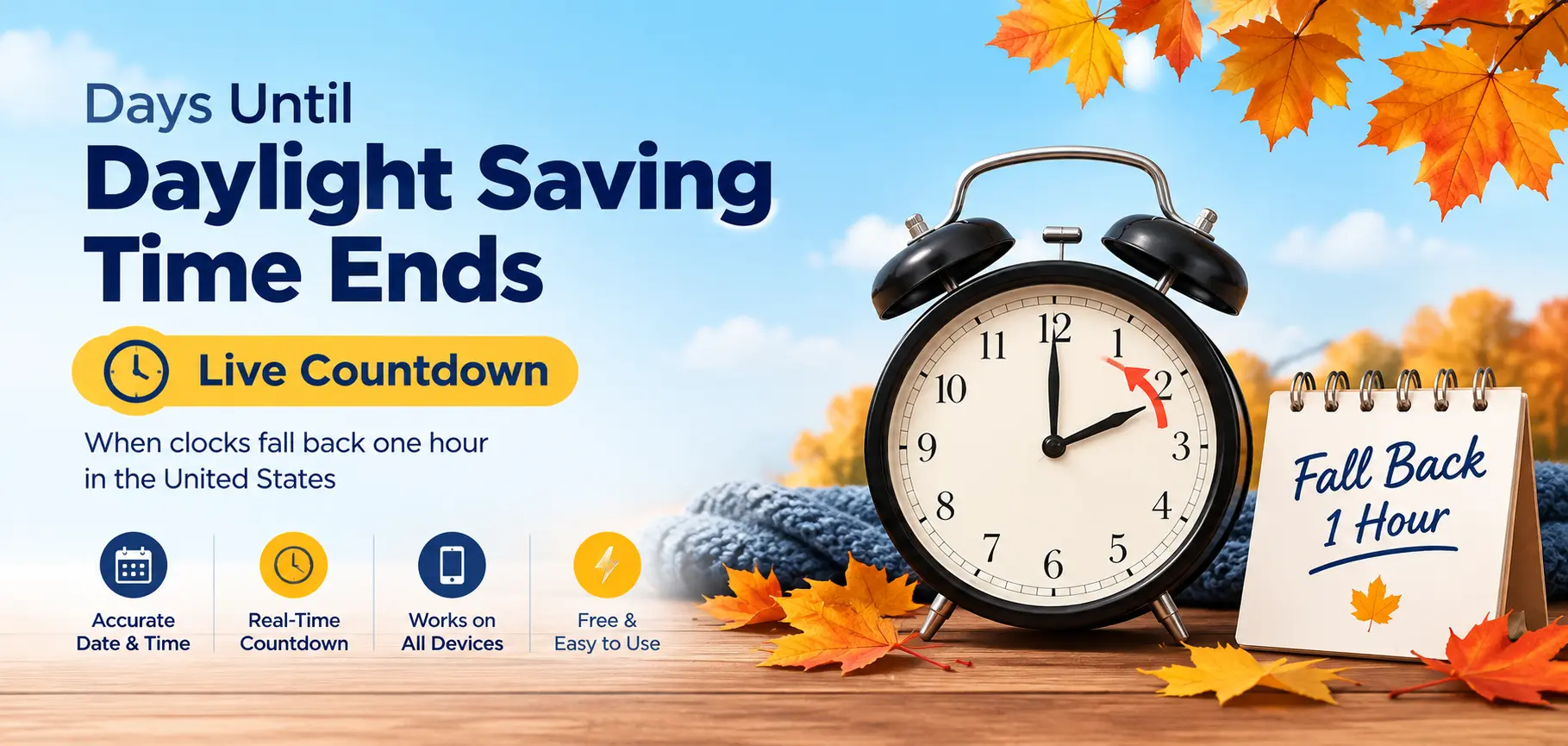
Track exactly how many days remain until clocks fall back one hour - trusted by users across the USA and Canada.
What Is Daylight Saving Time and When Does It End?
Daylight Saving Time (DST) is the practice of moving clocks forward by one hour in spring and back by one hour in autumn, so evenings get more natural daylight during the warmer months. In the United States, DST ends on the first Sunday of November, when clocks "fall back" one hour at 2:00 AM local time - and begins again on the second Sunday of March, when clocks "spring forward."
For 2026, that means Daylight Saving Time ends on Sunday, November 1, 2026, at 2:00 AM. At that moment, clocks move back to 1:00 AM, so the hour between 1:00 AM and 2:00 AM effectively happens twice. Most people experience this as gaining an extra hour of sleep.
The current US schedule was set by the Energy Policy Act of 2005, which extended DST to its present March-to-November window starting in 2007. Before that, the shorter schedule ran from April to October under the Uniform Time Act of 1966.
2026-2027 Daylight Saving Time Schedule
Daylight Saving Time dates vary by country. Here is when clocks change across the United States, Canada, the United Kingdom, and Australia:
| Region | DST Ends (Fall Back) | DST Starts (Spring Forward) |
|---|---|---|
| 🇺🇸 United States | Nov 1, 2026 | Mar 14, 2027 |
| 🇨🇦 Canada | Nov 1, 2026 | Mar 14, 2027 |
| 🇬🇧 United Kingdom | Oct 25, 2026 | Mar 28, 2027 |
| 🇦🇺 Australia | Apr 5, 2026 (opposite cycle) | Oct 4, 2026 |
Note: Australia is in the Southern Hemisphere, so its Daylight Saving Time cycle runs opposite to the Northern Hemisphere - clocks go forward in October and back in April.
Why Track the Countdown to Daylight Saving Time?
Knowing exactly how many days remain before clocks change helps with more than just curiosity - it affects sleep routines, travel plans, and scheduling.
- Sleep adjustment: Sleep experts recommend shifting bedtime by 10-15 minutes a few nights before the change to ease the transition.
- Travel and meeting planning: If you're scheduling flights, calls, or events that span the change date, knowing the exact day prevents time-zone mix-ups.
- Device and clock checks: Most smartphones update automatically, but ovens, car dashboards, and some smart devices need a manual change.
- Daylight awareness: Evenings get darker earlier once DST ends, which affects commute planning and outdoor activity scheduling.
A Brief History of Daylight Saving Time
Daylight Saving Time is often mistakenly credited to farmers, but historically farming organizations lobbied against it because it disrupted schedules tied to sunlight, not clocks. The modern concept is credited to New Zealand entomologist George Hudson in 1895, though Germany and Austria were the first countries to adopt it nationally, in 1916, primarily to conserve fuel during World War I.
In the US, DST rules were inconsistent from 1945 to 1966, causing confusion for interstate transport and broadcasting schedules. The Uniform Time Act of 1966 standardized the change dates nationwide for the first time, and the current November-to-March cycle has been in place since 2007 following the ISO 8601-aligned scheduling reforms of the Energy Policy Act of 2005.
As of this update, proposals like the Sunshine Protection Act to make Daylight Saving Time permanent have passed the US Senate more than once but have not been signed into law, so the twice-yearly clock change continues on schedule.
How to Prepare for the Clock Change
The switch back to Standard Time is usually easier on the body than the spring change, since you're gaining an hour rather than losing one. Still, a few simple steps make the transition smoother:
- Adjust gradually: In the 2-3 nights before the change, try going to bed 10-15 minutes later each night so your body clock shifts without a sudden jolt.
- Get morning sunlight: Natural light exposure shortly after waking helps reset your circadian rhythm faster than staying indoors.
- Update manual clocks first: Most phones, laptops, and smart devices update automatically, but ovens, microwaves, wall clocks, and car dashboards typically need to be changed by hand.
- Check smart-home schedules: Thermostats, security systems, and automated lighting that rely on time-of-day rules may need a manual review after the change to confirm they triggered correctly.
- Watch for sleep and mood changes: Some people notice mild fatigue or a dip in mood for a few days after the change, linked to shifting light exposure in the evening. This typically resolves within a week as your body adjusts.
If you're traveling around the change date, double-check meeting times and flight schedules against both time zones involved, since not every country changes its clocks on the same day - see the schedule table above for exact dates in the US, UK, Canada, and Australia.
Quick Facts About Daylight Saving Time
- It's not observed worldwide: Most of Asia, Africa, and countries near the equator skip Daylight Saving Time entirely, since day length there barely changes across seasons.
- The name is a bit misleading: Daylight Saving Time doesn't actually create more daylight - it shifts the same amount of daylight from morning to evening hours.
- Arizona is (mostly) the exception: The state opted out of DST in 1968 to avoid extending already-hot evenings, though the Navajo Nation within Arizona does observe it.
- Clocks change at 2:00 AM for a reason: This time was chosen because it falls after most bars and late shifts end but before early morning commuters and church services begin, minimizing disruption.
- Losing sleep has measurable effects: Some studies have linked the spring "spring forward" change to a short-term increase in traffic accidents and workplace injuries, attributed to lost sleep - an effect not typically seen with the November "fall back" change.
Frequently Asked Questions
⚠️ Disclaimer
This countdown is provided for general informational and planning purposes only. The exact moment Daylight Saving Time changes depends on your local time zone, and this tool calculates the countdown using your device's system clock, which may not always be perfectly accurate. Some US states, territories, and other countries do not observe Daylight Saving Time or follow different schedules. For official guidance, verify with your local government or the US Department of Transportation, which governs DST observance under federal law.
More Free Tools by AgeCalcAI
AgeCalcAI.com offers 40+ free online tools for everyday use - calculators, converters, and time tools. All tools are free, fast, and require no login. Serving users in USA, UK, Canada, and Australia.
Popular tools include our Age Calculator, Days Between Two Dates Calculator, Sleep Calculator, and our Hours Calculator. Browse all tools →